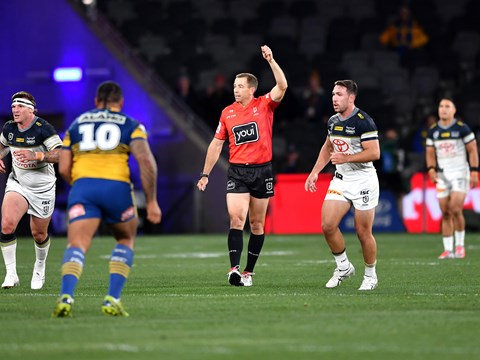
Since its introduction in 2020, the six-again rule has reshaped rugby league. It has delivered a faster, more continuous game and reduced stoppages — exactly what it set out to do. But from a fan’s perspective, there’s a growing sense that something important has been lost along the way: consistency.
Referees are often judged on the “four C’s” of officiating — concentration, confidence, consistency, and communication. Together, these qualities create control of the game. But if one stands above the rest, it’s consistency. Players and fans can accept mistakes; they understand referees are human. What they struggle to accept is inconsistency — and right now, the six-again rule is exposing that more than ever.
At its core, the issue lies in discretion. Set restarts are often decided on the finest of margins — seconds in the ruck or centimetres in the defensive line. One referee may call an infringement, another may let it go. Even within the same game, interpretations can shift as fatigue sets in and pressure builds. The result is a grey area that leaves fans questioning whether outcomes are being driven by performance or interpretation.
“Games are being influenced by seconds in the ruck and centimetres on the line.”
The rule also places enormous pressure on referees. A single six-again call can extend a set, build relentless pressure, and dramatically swing momentum. When multiple calls go one way, it can create the perception — fair or not — that the referee is managing the flow of the game, keeping scores tight or allowing a comeback. That perception alone is damaging, because it erodes trust in the contest.
The introduction of the captain’s challenge was a step forward. It added accountability and gave teams a way to question decisions — a mechanism to “keep everyone honest.” But that balance has been undermined by the six-again rule. As it stands, teams cannot challenge a set restart. That leaves one of the most influential decisions in the game entirely at the referee’s discretion, with no immediate avenue for review.
“The most influential call in the game is the one you can’t challenge.”
If the game is serious about fairness, the solution is straightforward: allow teams to challenge set restarts. Given how frequently they occur, there’s also a strong argument for increasing the number of captain’s challenges to two per team per game. If accountability improves, so too will confidence in officiating.
The six-again rule was designed to punish holding players down in the ruck and speed up play. While it has achieved that to some extent, it has also created sustained periods of fatigue. Fatigue leads to errors: mistimed tackles, high contact, poor technique, and ultimately more injuries. The rise in dangerous contact incidents is hard to ignore, and it aligns with the faster, more relentless pace the rule has created.
“A faster game has become a more fatigued — and more dangerous — game.”
Momentum has also shifted too far. A single set restart, combined with a 10-metre defensive line, can create overwhelming pressure. Sets snowball, and games can quickly feel unbalanced. What was once a contest built on structure and resilience can turn into a cycle of repeat pressure that is difficult to break.
And fans are noticing.
Recent polling from the Fans Have Your Say app highlights just how divided — and concerned — the rugby league community has become:
What best reflects your opinion on how the set restart rule is currently being used in the NRL?
- 33% – There are clear inconsistencies in how referees apply the rule—if this is fixed, I support keeping it.
- 33% – The rule is ruining the flow of the game, and referees are having too much influence on the outcome. I strongly dislike it—get rid of it.
- 22% – It looks like referees are using the rule to manage comebacks or keep scores close. There’s too much discretion and a lack of consistency across games.
- 6% – I’m happy with how the set restart rule is currently applied.
- 6% – I’m not sure what the solution is, but something definitely needs to change.
The message is clear: only a small minority are fully satisfied, while the overwhelming majority see inconsistency or a deeper issue with how the rule is applied.
When it comes to solutions, fans again point toward clarity and accountability:
How would you improve or fix the set restart rule in the NRL?
- 50% – Make the rule more consistent by introducing clearer guidelines for referees.
- 31% – Scrap the rule and return to traditional penalties.
- 13% – I’m unsure, but it’s not working as it stands.
- 6% – Reduce referee discretion and make it a reviewable or challengeable call.
- 0% – Keep the rule as it is—no changes needed.
And importantly, there is strong support for bringing balance back through the captain’s challenge system:
Should NRL teams be allowed to use the Captain’s Challenge to review set-restart decisions?
- 36% – I’m not sure – but something needs to counterbalance how discretionary this rule currently is.
- 29% – Yes – teams should be able to challenge set-restart calls, just like any other referee decision.
- 21% – Yes – but only in certain situations, like when it leads to a try or occurs in the final minutes.
- 14% – No – set-restarts should remain non-reviewable to keep the game flowing.
- 0% – I don’t have a strong opinion.
These results reinforce the central issue: fans aren’t necessarily against the rule itself — they’re against the inconsistency and lack of accountability surrounding it.
There is a middle ground. The six-again rule doesn’t need to be scrapped — but it does need refining. Reducing the defensive line from 10 metres to 7, or even 5, could maintain the speed of the game while reducing fatigue, lowering injury risk, and limiting extreme momentum swings.
Ultimately, this all comes back to the same point: consistency. The six-again rule, in its current form, is too discretionary. Interpretations vary, standards shift, and confidence suffers.
The captain’s challenge restored balance. The six-again rule has tipped it back, giving referees too much influence over outcomes without enough accountability.
Consistency is the cornerstone of good officiating. Right now, it’s the one thing the game is missing most — and until that’s addressed, the debate around six-again isn’t going anywhere.
——————————————————————————————————————————
Have Your Say – Be Part of the Data
Download the Fans Have Your Say app — it’s free on the App Store and Google Play.
🗳️ No typing.
🚫 No trolls.
⚡ Just fast, clean polls that shape the fan voice.